

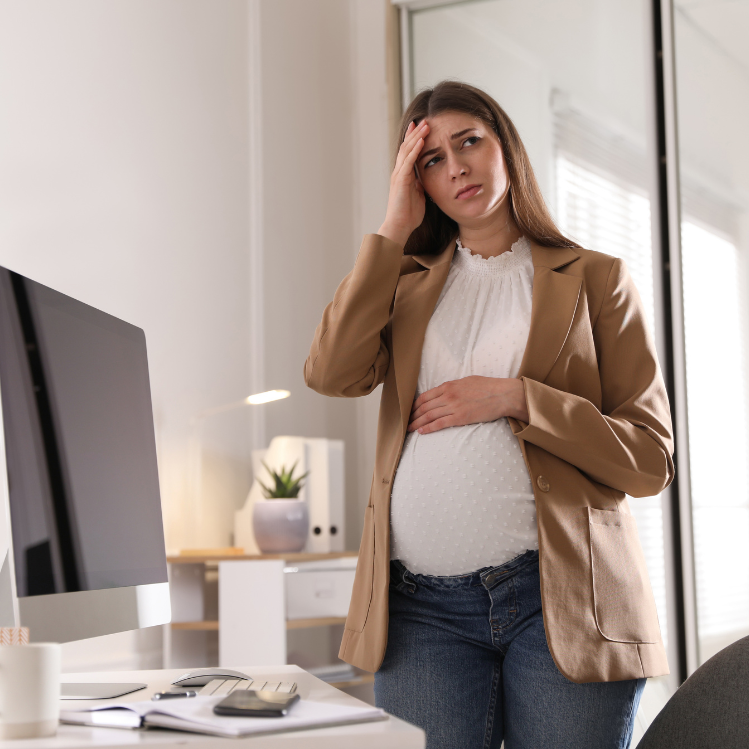
THE LONELIEST ROOM IN THE WORLD
What nobody tells you about building a business and growing a baby at the same time — and why community is not a luxury. It is survival.
By Jutta Wohlrab
The Problem: You Are Carrying Too Much. Alone.
You are sitting in a meeting. Or on a call. Or staring at your screen at 11pm.
Answering emails. Holding it all together.
And underneath the strategy, the deadlines, the clever and competent face you show the world —
you feel completely alone.
Not alone like nobody is home.
Alone like nobody sees me.
Here is what the research says.
46% of entrepreneurs struggle with loneliness and isolation.
90% of mothers feel lonely since having children.
39% of entrepreneurs feel they have no one to talk to about their stress.
Now imagine you are both.
Welcome to the loneliest room in the world.
Nobody designed it for you. Nobody warned you it existed.
But here you are. Carrying a business in your arms, a baby in your belly, and a smile on your face.
Because that is what strong women do.
Isn’t it.
Two Kinds of Loneliness. One Woman.
As an entrepreneur, you carry every decision alone. There is no colleague to think out loud with. No manager to share the weight. Research confirms that entrepreneurship is one of the most extreme occupations for loneliness — marked by high workload, high uncertainty, and a specific kind of isolation that erodes creativity, damages decision-making, and, if it goes unnamed, extinguishes passion entirely.
As a pregnant woman or new mother, your identity is quietly cracking open. Science has a word for this: matrescence. The sustained developmental process of becoming a mother. Physical. Psychological. Relational. Social. It has been compared to adolescence — hormonal, disorienting, profound — and just like adolescence, almost nobody tells you it is coming.
The people who understand your business do not understand your body.
The people who understand your body do not understand your business.
So you stand in the middle.
Fluent in both worlds. Belonging, some days, to neither.
‘The transition to motherhood is one of the most significant physical and psychological changes a woman will ever experience.’ — Psychiatrist Daniel Stern
Research shows that isolation is one of the strongest predictors of postpartum distress. And among entrepreneurs, loneliness has been directly linked to losing passion — and eventually walking away from the very thing they built.
This is not weakness.
This is one of the most demanding things a human being can do.
And the loneliness you feel is not a failure.
It is a signal.
The Solution: Community Is Not a Luxury. It Is Biology.
I have been working with women for over 40 years. In birth rooms. On stages. In coaching chairs. Across cultures and continents and every kind of professional life you can imagine.
And as an NLP trainer, I have worked with the architecture of the mind for decades. I know how powerfully language shapes reality. How a single reframe can shift a woman from I am failing to I am transforming. How being truly heard — by someone who actually gets it — changes the nervous system, not just the mood.
What forty years of experience and a lot of science agree on is this:
Connection is not comfort. It is a biological necessity.
Martin Seligman — the father of Positive Psychology — spent decades studying not what breaks people, but what makes them flourish. His answer became the PERMA model: five pillars that science has identified as essential to human wellbeing.
Positive Emotion. Engagement. Relationships. Meaning. Accomplishment.
Look at that list. Right in the middle: Relationships. Not as a bonus. Not as a nice-to-have.
From an evolutionary perspective, we are social beings because the drive to connect with others directly promotes our survival. Developing strong relationships is central to adaptation. And when our relationships make us feel supported, included, understood and cared for — we are set up for a lifetime of wellbeing. This is not soft language. This is science.
Not Just Any Community. The Right Community.
Here is what the research does not fully capture — but what I have watched happen in rooms with women for over four decades:
It is not just any community that changes things.
It is like-minded community.
Women who are in the same season as you. Who are also growing something — a business, a baby, a new version of themselves. Who speak both languages. Who do not need you to explain why you checked your emails at the birth prep class, or why you cried in a strategy meeting, or why some mornings you feel like a fraud in both roles simultaneously.
That recognition.
That ‘I know exactly what you mean’ from someone who actually does —
That is not just comfort.
That is medicine.
I have watched it work.
A woman walks into a room alone. Carrying everything. Holding her face together. She sits down. She hears another woman say something true — something she has never heard said out loud — and something in her chest unlocks.
Not because the problems are solved.
But because she is no longer the only one.
That shift — from isolation to belonging — changes what she believes is possible. It changes how she births. It changes how she leads. It changes how she shows up for herself.
‘Working proactively on connection and relationships not only increases wellbeing — it directly decreases psychological distress.’ — Seligman, PERMA Research
You were not built to do this alone.
Not the pregnancy. Not the business. Not the becoming.
You were built for exactly what you are doing.
But you were built to do it with someone.
With women who get it. Who have been there, or are right there beside you. Who can say: yes, I know. Me too. And here is what helped.
That is not weakness.
That is how human beings survive.
That is how they flourish.