

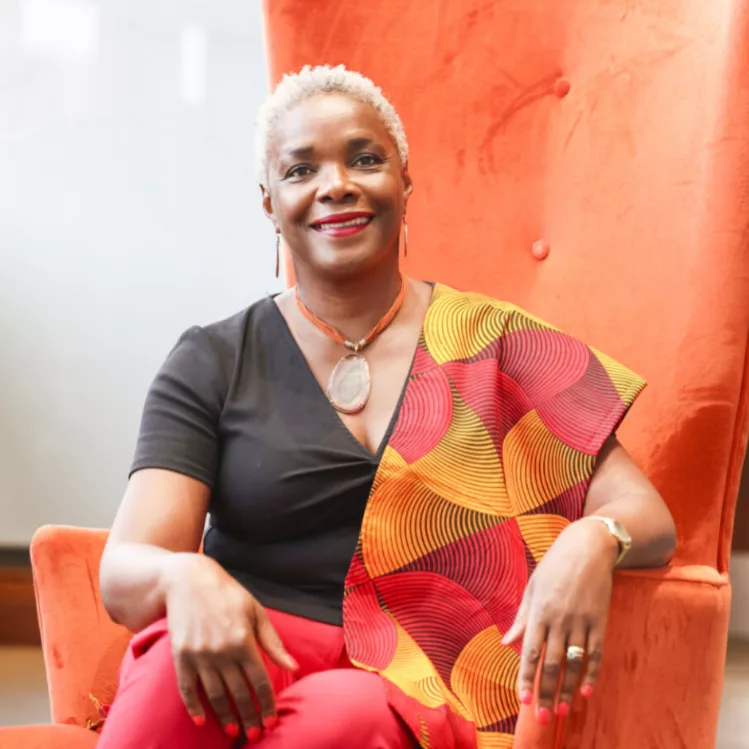
Prof Laura Serrant: The Moment That Lit the Fire for Health Equity
For more than three decades, Professor Laura Serrant has been a defining voice in the fight for health equity, social justice, and inclusive leadership. Her work has reshaped how institutions confront inequality, how leaders understand their responsibility, and how communities reclaim their narratives. But long before she became one of the UK’s most respected nursing leaders, researchers, and global D&I consultants, there was a single moment early in her career that set everything in motion — a moment that revealed not just the gaps in our systems, but the silences that allow them to persist. What followed was a lifelong commitment to courage, accountability, and amplifying the voices too often unheard.
“Health equity requires courage, accountability, and confronting uncomfortable truths.”

What pivotal moment or experience in your early career shaped your passion for health equity and social justice?
I often say that my passion for equity wasn’t something I discovered — it was something I recognised. Very early in my nursing career, I realised that many of the disparities people experienced were not simply clinical but structural. One moment in particular stands out was during my time as a nurse in the 1980s AIDS pandemic – supporting a young man who felt entirely unseen and silenced within the system. His care was shaped more by assumptions made about him than by his actual needs. That experience crystallised something for me — that health equity requires more than compassion; it requires courage, accountability, and a willingness to confront uncomfortable truths. It was the beginning of my lifelong commitment to standing with those whose voices are overlooked or silenced.
You’ve led groundbreaking work on racial and ethnic inequalities in healthcare. How do you approach the challenge of driving systemic change in deeply rooted institutions?
Systemic change is rarely dramatic at first — it is the steady, intentional pressure that makes the difference. My approach blends truth‑telling with strategic partnership. I start with evidence that exposes the issue clearly, but I pair that with stories that illuminate the human reality behind the data. Institutions resist change not because people don’t care, but because systems are designed to protect themselves. So my work focuses on shifting mindsets, building alliances, and creating a climate where leaders can no longer look away. Change becomes inevitable when awareness is transformed into ownership.
The ‘Silences Framework’ has had a wide-reaching impact across sectors. How did it come to life, and why are ‘silences’ so crucial?
The Silences Framework emerged in 2010 following my PhD work completed in 2004 and years of observing the gaps that consistently appeared in research, policy, and practice. I noticed that entire communities — their experiences, their needs, their insights — were missing from the narratives shaping their care. These were not accidental omissions. They were structural ‘screaming silences’. To challenge inequity, we must first name what is absent. The Framework helps people identify these gaps, understand why they exist, and take action to address them. Silences matter because they distort truth, limit progress, and allow inequality to persist unchallenged. By bringing them into the light, we create space for real transformation. It now forms the roots of my business approach to leadership The Lioness Effect which helps how we lead with integrity and impact to ensure equity, inclusion and effectiveness in our work as leaders.
As one of the few Black research professors in the UK, how have you navigated the intersections of identity, leadership, and academia?
Being a Black woman in academia has often meant standing in spaces not designed with me in mind. I quickly learned that my identity was not a barrier but a source of insight, resilience, and purpose. I made a commitment early on to show up fully — not shrinking to fit expectations, and not allowing others’ discomfort to define my journey. Leadership, for me, is about using my presence to challenge assumptions and open pathways. It has sometimes meant being ‘the only one’ in the room, but I carry with me the knowledge that my presence makes it possible for others to follow. My role has always been to create space, not simply occupy it.
With over 35 years of experience, what lessons have you learned about leading with authenticity in resistant environments?
Authenticity is often misunderstood as vulnerability alone. For me, it is a form of strategic clarity — a grounding force. When you lead from who you truly are, your compass becomes steady, even in turbulent environments. I have learned that authenticity invites trust, and trust fuels change. It also demands consistency: your words, actions, and values must align, even when systems push back. Over time, I’ve found that authenticity not only strengthens your leadership, it strengthens the people around you. It is a quiet but powerful refusal to conform to what diminishes you.
What advice would you give to young women — especially women of colour — aspiring to leadership roles?
My advice is simple but profound: you are already enough. Your lived experiences are not obstacles but unique sources of wisdom and resilience. Do not let anyone convince you that your perspective is supplementary — it is essential. Build your pride, your community, your network of lionesses. No one thrives alone. Seek roles where your influence can shape systems, not just support them. And walk with courage. The world often adjusts its expectations only after we step forward, not before.
In 2024, you became a Freeman of the City of London and received a CBE. How do these honours influence your mission?
Receiving the CBE and the Freedom of the City of London was deeply affirming, not for me personally alone, but for the work and the communities I represent. These honours signal that speaking truth to power, challenging inequity, and amplifying unheard voices matter. They energise me to continue pushing boundaries and ensuring visibility for others. They remind me that leadership is both responsibility and privilege — and that I must continue using my platform to widen the circle of recognition and opportunity.
As a global D&I consultant, what do you see as the most urgent priorities for creating inclusive cultures?
Three priorities stand out. First, psychological safety — without it, diversity becomes symbolic rather than transformative. Second, leadership accountability — inclusion must sit at the heart of organisational strategy, not on the periphery. And third, equitable access to opportunity and visibility — talent exists everywhere, but opportunity does not. Organisations must dismantle the systems that exclude. Inclusion is not an initiative; it is a way of operating.
Your podcast *Speaking for Ourselves* gives voice to lived experiences. What inspired it, and what impact has it had?
I created *Speaking for Ourselves* because I wanted to build a space where people could share their stories without translation or apology. Too often, lived experience is filtered, softened, or silenced entirely. I wanted to reclaim that space. The most surprising impact has been the global reach — messages from people who say, ‘I heard myself in that story.’ That is the power of narrative. It unites us, challenges us, and reminds us that truth spoken authentically resonates across borders.
How does your Dominican heritage influence your values and leadership style?
My Dominican heritage is woven through everything I do. It taught me resilience shaped by community, pride shaped by humility, and leadership shaped by collective purpose. Growing up in a Caribbean household, I learned that we rise by lifting others. That belief forms the core of my leadership. My heritage reminds me to lead with joy, strength, and connection — and to ensure that the work I do creates pathways for those who follow.
“Leadership is showing up fully and creating space for others to follow.”