

Christina Vidovich: 5 Values of Visibility
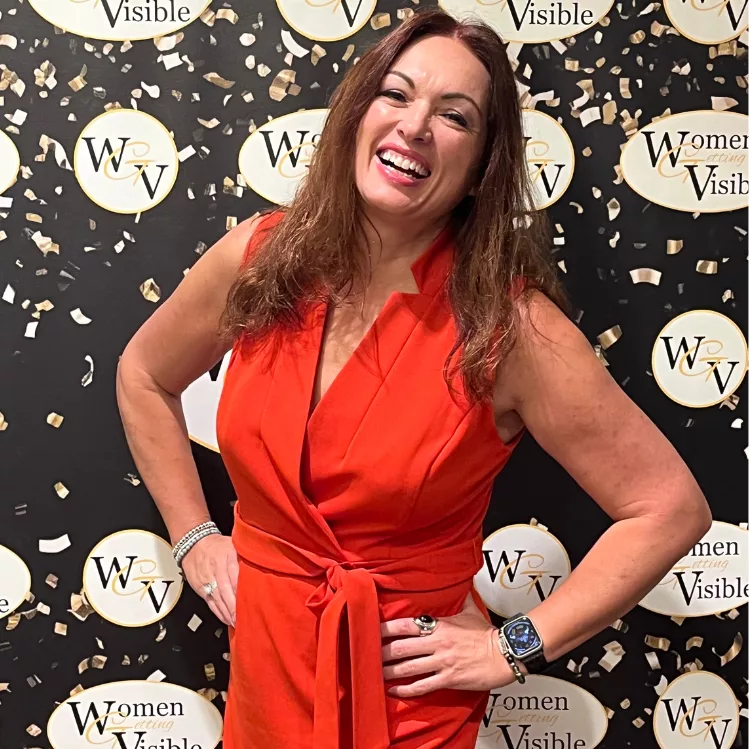
Christina Vidovich is on a mission to help women step into the spotlight. As the creator of the “5 Values of Visibility” framework and founder of Women Getting Visible, she empowers women around the world to be seen, heard, and valued—at home, at work, and everywhere in between. From her experience as a professional ballroom dancer to a media producer and entrepreneur, Christina blends storytelling, leadership, and presence into a movement that’s transforming how women lead and share their voices globally.
“Visibility begins where a woman chooses to be seen.”
You created the “5 Values of Visibility” framework. Can you walk us through what inspired it and how it helps women step into being confidently seen and heard?
Interviewing women from around the world, listening to their stories, and noticing where they felt most invisible is what inspired the “5 Values of Visibility” framework. Each conversation became a piece of research into what visibility really means in a woman’s life, and over time five themes kept repeating: Speaking, Community, Self‑Confidence, At‑Home, and At‑Work.
Women described feeling unseen in meetings, overlooked in their own homes, or doubting their right to take up space, and those lived experiences shaped every part of this model. When we understand exactly where a woman feels invisible, we can begin working on that space together and then watch how each area of her visibility journey strengthens the others, so she can be seen, heard, and valued in both her personal and professional life.
Women Getting Visible has become a global movement. What gap did you see in women’s leadership and storytelling that motivated you to launch it?
Women Getting Visible was born from a deep passion and from hearing the call of other women who were frustrated with how hard it was to get their message out into the world. There are women everywhere doing extraordinary things, leading rooms, building businesses, caring for families, and creating innovations, and yet women still hold only about 29 percent of C‑suite roles. There are countless brilliant female authors and experts, but in so many conversations the default “go to” authority is still not a woman.
Part of the gap is structural and cultural. Men are already seated in many of those top roles and often hire within the networks they already know and trust, which tends to mean more men in the same spaces. Women, on the other hand, carry different pressures and expectations and often even have to speak differently in male‑dominated environments. On top of work, they are expected to be visible at home, to be the primary caregivers, and to be the ones who may pause or step back from a career for family.
As the daughter of a respected immigrant pediatrician, my mother was my first model of what is possible for a woman. She taught me that a woman must be able to stand on her own, financially and emotionally, and to never outsource her sense of worth to anyone else. Her story, and the stories of so many women like her, are the backbone of my podcast interviews and conversations, and they are a constant reminder that representation and storytelling are not luxuries, they are lifelines.
Women Getting Visible exists because these stories are not being told often enough or broadly enough, and that is not just a local issue, it is a global one. Through this movement and framework, the goal is to create spaces where women’s leadership and storytelling are seen as essential, not optional. When women share their stories on stages, in boardrooms, online, and at home, they shift culture, challenge who is seen as an “expert,” and open doors for the next generation to walk through with less hesitation and more confidence.
As a former professional ballroom dancer turned media producer and entrepreneur, how have these diverse career chapters shaped your approach to visibility and leadership?
There are many parallels between my life as a professional ballroom dancer and my work today as a media producer and entrepreneur. As a dancer, I became comfortable with being visible. All eyes are on you, whether you are performing or instructing, and every movement must be both precise and artistic. At the same time, ballroom is a partnership. It is a constant balance between two people, communicating lead and follow, timing, and emotion through the body and through the music.
Those lessons directly shape how I see visibility and leadership. Great leaders, like great dancers, pay close attention to both what they say and what their body language communicates. They understand rhythm in a conversation, when to step forward and when to make space for someone else. Moving into the media space allowed me to translate those skills into storytelling on camera and on audio, capturing presence, narrative, and emotion in a different medium to keep audiences engaged.
As a producer and entrepreneur, I think of every project like choreography. Whatever message you are putting into the world, you are responsible for every element, because people will experience it from every angle. Strong leaders, like strong performers, learn how to handle missteps with grace, whether it is a missed step on the dance floor or a mistake on a video shoot, and continue to move forward with fluidity. That is how you build a business you can run from head to toe, while treating your team as a true partnership of leaders.
You’ve taught over 20,000 dancers and produced more than 400 podcast episodes. What parallels do you see between movement, storytelling, and leadership?
Both dancing and podcasting are about creating an experience that others can feel and follow, and leadership is the same. Dance is storytelling without words. Every step, pause, and turn communicates something, whether it is the emotion in the music or the relationship between partners. In podcasting, words carry the story, but the goal is the same, to make your message clear, engaging, and meaningful for the people in front of you.
In the studio and on the dance floor, you learn quickly that you cannot lead well if you are not paying attention. You listen to the music, you read your partner, and you adjust your timing and energy so you move together instead of against each other. The same is true for interviews. A good host listens closely, notices strengths and hesitations, and adapts the way they communicate so each person feels supported, seen, and at their best.
The biggest parallel to leadership is that none of these roles are about performing over people, they are about leading with them. Whether I am guiding a room of dancers, interviewing a guest, or leading a project, my focus is on creating a shared rhythm, a clear direction, and a trust that we can navigate the journey and arrive where we want to go together.
With your multicultural heritage and world-travel experience, how does a global lens influence the way you support women in amplifying their voices?
My global experience has made me very aware of how different a woman’s reality can be, depending on the culture of where she lives. In the United States, women are starting nearly half of all new businesses and own millions of companies, which means many of us have the chance to choose our path, build something of our own, and use our voices in public and professional spaces. Yet here we are in the 21st century, and safety, opportunity, and freedom are still not experienced equally by every woman globally. There are women whose basic rights and visibility remain heavily restricted.
“Amplifying voices” is not a slogan to me, it is a responsibility. If I have the ability to get an education, start a business, speak on stages, and host a podcast, then I want to use that access in service of women who are ready to step forward and be seen. My global lens reminds me that every story we tell is exempt of borders. Stories can travel far beyond one city or one country, and can become a mirror or a lifeline for a woman who is wondering if her voice matters.
As I support women in amplifying their voices, I am always thinking about them as part of a global community. I want each woman to see herself as a leader in her own home, in her business, and within herself. She is part of a wider movement of women changing what leadership looks and sounds like around the world. When one woman speaks up with confidence, she does it for herself, and she also quietly expands what is possible for women she may never meet.
“When one woman speaks, she expands what’s possible for many.”
Visibility can be intimidating for many women. What are some of the most common fears you encounter, and how do you help women move through them?
Many of our fears do not start with us. They come from words that have been put on us by others, from doubt, jealousy, and from people who love us but have never been taught how to celebrate others. Over time, those outside voices start to sound like our own inner voice, telling us to stay small, stay quiet, and not make anyone uncomfortable.
One of the first things I help women do is see that those outside forces have been shaping their inner narrative. When you realise that, you can start to choose a different story. You stop and take inventory of what you have actually done, created, and survived. You look at your own track record of accomplishments and start to recognise the power you already have within you.
From there, it becomes about grace and permission. Grace, to stop beating yourself up for not being “farther along,” and permission to share your brilliance with the world in the way that feels right for you. I ask, “What happens when you say yes to you?” The only way to find out is to take one visible step, try, and let your own experience show you that your voice can be stronger than fear.
As a homeschooling, remote-working mother, what insights have you gained about balancing leadership, business, and family while still showing up visibly and powerfully?
Family is first, always. Taking care of the emotional needs of my family and having quality time with them is the most important aspect of my life and the memories we are making; it is more important than any conference, meeting, or activity in the world. When I know I have met the basic needs of my child and I am giving a truly global education, then I can step into my work with a clear mind and an open heart.
We travel the world, and every city we live in or explore becomes a classroom. My child is a student of the world, and I am learning alongside, through local cultures and people. I hold workshops and meetings wherever we go, so my child sees, in real time, what it looks like to be a global citizen who leads, serves, and stays rooted in family.
By showing my child that family comes first, I am raising a human who will respect family and also see that you can travel the world, run a business, and still have the time to live the lifestyle you want. We do not have to follow the script of “go to school for 20 years, then work 9–5 until you retire.” Success, to me, is defined by how you live, how you love, and how aligned you feel with the life you are creating, and you are the creator of that destiny.
What trends are you seeing in the way women are using stages, media, and online platforms to shape conversations and create impact today?
One of the biggest trends I see is women showing up more genuinely, not just more often. There is a big push around the phrase “authentic self,” but I prefer the word genuine. Genuine, to me, means it comes from the heart and that every word and action is rooted in your values, not just in what is popular at the moment.
Authentic has started to carry a connotation of “I am just being me right now, no matter what,” but as creators and leaders we also need to be responsible for the content we put into the world. I appreciate that more and more women, at every age, are sharing their messages and their stories without waiting for perfection. They are not letting hair, makeup, or lighting stop them from speaking up. They are choosing to prioritise the message over the polish, and that is more powerful than any trend.
What matters most is that the conversations are real and come from the heart. When women speak on stages and show up online with that genuine energy, people can feel it. The people watching and listening will know when you are being genuine, and that is what shapes conversations and creates real impact.
In your work with emerging and established leaders around the world, what qualities stand out among women who create lasting legacy through their work?
First, they have a genuine desire to help others without a price tag attached. They understand that we all need to make a living and care for ourselves and our families, but their instinct is generosity. They would give the blouse off their back to help someone in need, and that spirit of service shows up in how they lead and how they build their businesses.
Second, they are driven by a purpose that is bigger than themselves. Their work is rooted in a passion or calling that goes beyond personal recognition or achievement. They care deeply about the greater good, the communities they serve, and the change they want to see in the world, and that sense of purpose keeps them moving even when things are hard.
Third, they make time for people. Even with full calendars and big responsibilities, these women slow down enough to look someone in the eye, have a real conversation, and treat each person as an equal, not as a transaction. They listen with sincerity, ask thoughtful questions, and bring a level of empathy and respect that makes people feel seen and valued. Those are the leaders whose impact lasts, because people remember how they were treated as much as what they accomplished.
What’s next for Women Getting Visible? Are there upcoming initiatives, conferences, or collaborations you’re excited about?
Women Getting Visible is still in its first year, but it has already made an impact as a fast‑moving global movement. It started as a vision, and within five months of that first idea, I held a three‑day conference with 21 speakers, establishing its force and the deep desire for visibility.
Let me say this clearly: I do not do collaborations, I do partnerships. Just like in dance, I believe in coming together as equal partners to create something powerful. A collaboration can feel like a promise; a partnership is a commitment, where everyone tells their story and everyone is celebrated in the outcome. This is the spirit of visibility and I am open to partner and celebrate women entrepreneurs.
I am partnering with women around the globe to put on workshops and events in multiple cities as I travel. There is a monthly rhythm of workshops and visibility experiences planned, and I already have dates set for my next two conferences in the coming year, which means three conferences within one year, with outlines for the next four cities already in motion. I am excited to continue expanding this visibility tour and to welcome more women to share their brilliance in each location.
Women Getting Visible came to me as a vision, and it has quickly proven that women are ready for this kind of space. What is next is more stages, more cities, more partnerships, and more women stepping into the spotlight to be seen, be heard, and be valued on this magical journey to uplift women’s global visibility.