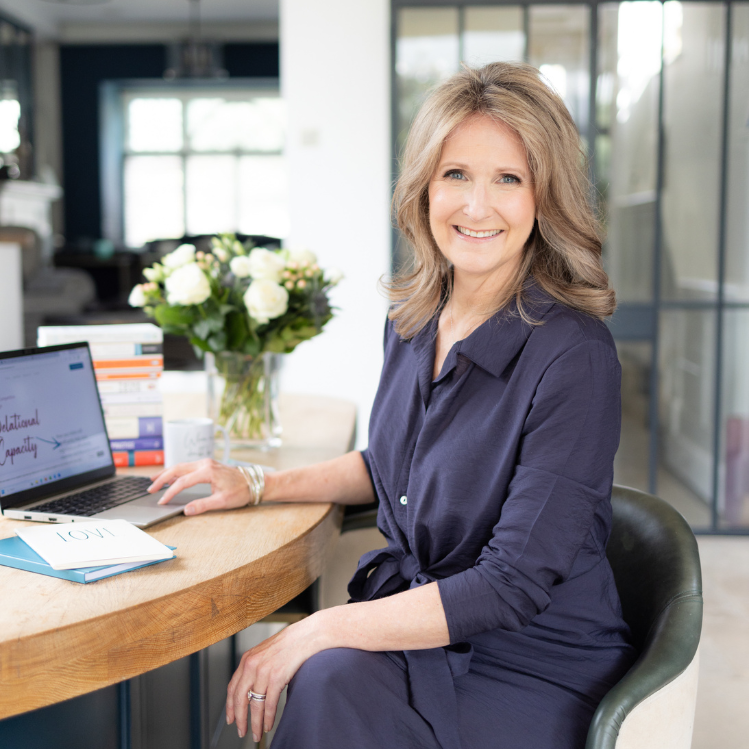



Kerry-Lyn Stanton-Downes: Beyond Words and Into the Heart of Human Connection
In an age of constant noise and instant messaging, Kerry-Lyn Stanton-Downes is quietly leading a revolution in how we connect.
A relationship psychotherapist, advisor, and now author, she has spent more than two decades working at the crossroads of personal healing, leadership development, and cultural transformation. Born in Rhodesia and raised in South Africa before moving to London, Kerry-Lyn has built a reputation for blending depth psychology, relational neuroscience, and systems thinking into work that is as practical as it is profound. Whether guiding C-suite executives through high-stakes change, helping couples navigate rupture and repair, or designing trauma-informed cultural interventions for organisations, her approach is rooted in one truth: the quality of our relationships shapes the quality of our lives. With her debut book Beyond Words, she distils years of clinical and organisational experience into eight embodied principles for living, working, and leading with greater trust, safety, and connection.
You grew up in Rhodesia and South Africa before moving to London. How did those early environments shape your understanding of human connection?

I often say I grew up in two countries, trying to navigate differences — and failing. Rhodesia and South Africa were, and still are, beautiful and brutal in equal measure. On the one hand, I was surrounded by breathtaking landscapes. On the other hand, I witnessed — and absorbed — the deep relational cost of fear, separation, and survival.
Both countries were marked by tension and a sense of threat. And when we’re trapped in a survival state, connection becomes almost impossible. Even as a child, I could feel this.
And yet, I noticed something else, too. Nature didn’t seem to care who we were, where we came from, or what we believed. In the bush or by the ocean, there was a shared stillness. Those moments showed me that under the fear, noise and division, we are wired to connect. I believe that is what ultimately led me to the work I do now — helping people move from survival to safety by paying attention to the quality of the way we relate.
What drew you to relational therapy — was there a moment when you realized this work was your path?
There was a very clear moment. I was working in an art gallery — feeling disconnected and, honestly, a little lost. I was invited to an event I didn’t want to attend, but I went. Shortly after arriving, my boss’s wife — who happened to be a psychotherapist — came over and struck up a conversation.
We stood in the same spot for over three hours, deep in conversation about life, relationships, and philosophy. It was one of those rare moments when time disappears and something inside you starts to wake up.
At the end of the night, she looked at me and said, “I know where you need to be. And my husband isn’t going to like it.”
The next morning, my boss handed me an envelope. Inside was the prospectus for a psychotherapy training programme. The minute I opened it, I started to shake — not from fear, but excitement. Something in me just knew. Three months later, I was there, studying.
It felt less like a decision and more like a remembering. As if the path had been waiting for me all along — I just needed someone to point it out for me.
You talk about “relational poverty” — what does that mean, and why is it such a pressing issue today?
Relational poverty is what happens when the space between people breaks down.
You feel it everywhere – in the heavy silence at the dinner table, the unspoken question in a meeting, the moment someone looks past you instead of at you, or when they’re typing on their phone while you’re talking. It lives in both big and small interactions, and it’s not always loud. More often, it’s a quiet absence: a lack of presence, a sense of not being seen or heard.
Every one of those moments happens in the space between people – in the relationship. And when that space is polluted, psychological safety breaks down. Trust, honesty, compassion, kindness, loyalty and connection all start to erode.
As the world rushes headlong into the AI era, more and more of our time is being consumed by it, quietly distancing us from each other. And while AI may be faster, cleverer and even more convincing, it cannot co-regulate a nervous system. It cannot sit with someone in their pain or their joy. It cannot feel.
Right now, most of our energy is going into tackling mental health, which is often the symptom of relational poverty. In the UK alone, organisations are spending over £50 billion a year trying to fix mental health as though it’s a problem that lives inside the individual brain. But the brain is a relational organ. We are shaped in relationship, we heal in relationship, and we grow in relationship.
Research shows that when we change the way we relate, everything changes. Psychological safety improves. Trust rebuilds. Creativity, connection and resilience return – whether in the boardroom or around the kitchen table.
Right now, remembering how to be human – with ourselves and with each other – isn’t just important. It’s urgent.
In your experience, what do most people misunderstand about what it takes to build healthy, lasting relationships?
The deepest misunderstanding is believing that just because we are born in relationship, and wired for relationship, we know how to be in relationship. I believe we are born with the capacity, just not the competence.
Most people assume relationships will work because connection can feel natural – but understanding how to build and sustain them is another matter entirely.
Yet healthy, lasting relationships – whether with a partner, friend, colleague, or team – require us to commit to self-growth, to pay attention to the quality and speed of the repair after a rupture, and to choose relationship over being right.
When we stop assuming and start relating with purpose, we begin to create relationships that aren’t left to chance – they become spaces safe enough to be honest, resilient enough to weather difference, and rich enough to bring out the best in each of us.
You’ve trained in so many therapeutic models — how do you decide what to bring into your sessions with individuals or couples?
I’ve trained in many therapeutic models, but I don’t start with the technique — I start with the human being in front of me. I hold a governing belief that no matter how unusual or self-defeating a behaviour might appear, it always makes complete sense in the context of that person’s internal world.
When we can uncover the deeper emotional truth — the lived experience that makes this way of being feel necessary — we create the conditions for real change. At that point, the choice of modality becomes secondary. I can draw from any of the approaches I’ve trained in as long as they honour that central truth.
That’s why my training spans so many models. They each offer different tools, and at the same time, they all align with this core belief: when we work with the underlying emotional meaning, the system can shift from simply surviving to truly thriving.
What’s the biggest shift that can happen when a couple moves from conflict to connection?
The biggest shift in any relationship is that it moves from surviving to thriving.
When two people conflict, their nervous systems are in a state of high alert. Whether they realise it or not, they are seeing each other as a potential threat – so every word, look, silence and withdrawal is filtered through their survival lens.
When we learn how to regulate our nervous system and co-regulate with each other, something fundamental changes in each person and the space between them.
The wonderful thing is that conflict and difference become a place for growth – an opportunity to understand each other better and rebuild trust.
In the process, lightness returns, and fun and laughter become part of the relationships again. That shift – from ‘you are dangerous’ to ‘you are safe’ – changes everything.

How do you help leaders and businesses build cultures that are not just productive, but also deeply relational and safe?
I start by helping leaders see that productivity, resilience, collaboration, psychological safety and innovation are not the starting point – they’re the outcome. The real input is the way we relate. If the relational space is strong – if people feel seen, safe and able to speak openly – those outcomes follow naturally. When the relational space is polluted by mistrust or disconnection, productivity drops no matter how strong the strategy.
We begin by focusing on the quality of the way they relate to each other – how they speak to each other, what happens in moments of difference, how feedback is given and received. These micro-moments, repeated hundreds of times a week, are what shape culture.
And I do this by introducing the 8 Principles of Relational Capacity – Presence, Curiosity, Reflection, Respectful Candour, In Service, Mindset of Abundance, Navigating Difference and Vulnerability – practical, evidence-based ways of relating drawn from neuroscience and over two decades of practice. The principles help leaders shift from reaction to reflection, from performance to presence, and from silence to respectful candour. Because when you change the way people relate, the output is transformed: productivity rises, people take ownership, creativity flows, and collaboration becomes the default. Rather than trading results for relationships, they discover that strong relationships make for better results.
You’ve worked with elite performers, founders, and even the British Transport Police — how do you tailor your approach for such different environments?
While the environment might change — from a football pitch to a boardroom to a police briefing room —the message is the same: when we change the way we relate, everything changes. The starting point is always the same — what’s happening in that person, the other and the relational space. That’s because performance, resilience, trust, and psychological safety are all outcomes of the quality of our relationships, both with ourselves and with others.
For an elite performer, that means looking at how they relate to themselves, their team, their training, and even the game itself. When they can regulate their nervous system under pressure, stay present in the moment, and connect meaningfully with those around them, they perform with greater precision, recover faster from setbacks, and strengthen the bonds that make teams thrive.
With founders, the focus often shifts to how they relate to their vision, their people, and the relentless uncertainty of building something new. When a founder learns to stay relational in the middle of the chaos of start-ups — listening deeply, repairing quickly, and creating psychological safety for their teams — they unlock not just better culture, but better business outcomes: higher retention, more innovation, and a team willing to go the distance.
And in environments like the British Transport Police, the stakes are different again — but the principle still holds. High-stress, high-responsibility roles demand the ability to stay regulated, build trust fast, and communicate clearly under pressure. By focusing on the quality of the relational space, officers are better able to respond even in the most difficult circumstances.
Your forthcoming book, Beyond Words, offers eight embodied principles. If someone could start with just one, where should they begin?
I always say — start with the principle that speaks to you most. The eight principles in Beyond Words, which I mentioned above, aren’t a checklist you have to tackle in order; they’re different doors into the same house. In my therapy and organisational work, I use them all, but where we begin depends on where someone is right now. Everyone resonates with a different principle at a different moment — sometimes because it’s the skill they most need, and sometimes because it’s the one they feel most able to take on.
Each principle is an entry point, and once you start working with one, you’ll find it naturally leads you to others. Take presence, for example. You can’t stay present if you’re not reflecting on what’s happening for you — your thoughts, emotions, and the sensations in your body. And once you start reflecting, curiosity follows. You begin wondering what’s happening for the other person, which opens the door to respectful candour, and so on.
That’s the beauty of this work: it’s interconnected. And because these principles can be applied and embodied, you don’t just understand them in your head; you feel the change in your body, your conversations, and your relationships. Every small shift in the way you relate creates a ripple, and those ripples can transform not just one relationship, but the culture around you. The power is in the beginning.
What gives you hope today when you look at how people are learning to live, love, and lead more consciously?
What gives me hope is that people are starting to realise we can’t think our way into better relationships — we have to experience our way there. I see more leaders, couples, teams, and communities recognising that change doesn’t come from perfecting a script or learning a clever technique, but from the courage to show up differently in the moment: to listen more deeply, to repair quickly after rupture, to be present even when it’s uncomfortable.
I see a hunger for connection that goes beyond networking or small talk — people are yearning for relationships where they can bring their whole, unpolished selves and still feel safe. That hunger tells me we’re waking up to what sustains us. And in the spaces where people commit to doing this work, I’ve seen things transform: teams that were stuck in blame and silence begin to laugh together again, couples who were barely speaking find their way back to tenderness, leaders who were running on empty rediscover joy in leading.
I also see a shift in language — words like “psychological safety,” “co-regulation,” and “relational trust” are entering the mainstream. That matters because when we have language for something, we can work with it. And when people understand that the quality of their relationships is not fixed, but something they can actively strengthen, the possibilities for change multiply.
When we change the way we relate, we change what’s possible.